

Powered by Kavout
Investment research often becomes overwhelming long before an investor reaches a decision. Financial statements, technical indicators, market news, sentiment data, valuation metrics, and portfolio risks may all point in different directions. Reviewing every source manually can consume hours while still leaving important questions unanswered.
AI financial research agents offer a more structured way to approach this workload. Kavout brings several analytical tools into one platform, allowing users to investigate opportunities, compare evidence, monitor selected assets, and organize their findings without relying on a single metric.
Begin With a Clearly Defined Research Question
A productive research session should begin with a specific question rather than a broad request for “good stocks.” The investor might want to examine a company’s valuation, compare its financial health with competitors, review recent price momentum, or understand how current news could affect market sentiment.
Kavout’s InvestGPT is designed as a conversational financial research agent covering stocks, ETFs, cryptocurrencies, and forex. Its available research modes include investment ratings, fundamental analysis, technical analysis, market outlook, news sentiment, and trade-focused research. This makes it easier to select an analytical direction before reviewing the results.
Beginning with a narrow question also reduces the risk of collecting large amounts of information that do not contribute to the final decision.
Separate Fundamental Evidence From Market Behavior
Fundamental analysis and technical analysis answer different questions. A company may appear financially strong while its share price remains under pressure, or it may show strong momentum despite an expensive valuation. Combining both perspectives can provide a more complete picture than relying on either one alone.
Kavout evaluates stocks across dimensions that include quality, value, growth, and momentum. Its fundamental research tools examine areas such as valuations, financial health, balance sheets, and peer comparisons, while its technical analysis tools review price action, chart patterns, and multiple indicators across different timeframes.
Keeping these categories separate during the first stage of research makes conflicting signals easier to recognize. They can then be compared during the final review rather than blended into one unclear conclusion.
Use AI Stock Rankings as a Starting Point
Stock-picking tools are most useful when treated as discovery systems rather than automatic instructions. Their purpose is to reduce a large market universe into a manageable list of candidates that deserve further investigation.
Kavout’s AI Stock Picker analyzes more than 9,000 U.S. stocks daily and organizes ideas through multiple AI-enhanced strategies. Users can explore approaches related to value, quality, growth, momentum, and balanced multi-factor selection, while filtering results by market segments such as large-cap, mid-cap, small-cap, the S&P 500, and the Russell 1000.
A sensible workflow is to identify several candidates, determine why each one appeared in the ranking, and then investigate the underlying data. This maintains human judgment while using AI to accelerate the discovery stage.
Check Whether Different Signals Agree
One analytical signal rarely tells the whole story. A technical indicator may suggest improving momentum while valuation measures remain unfavorable. News sentiment may appear positive even though financial performance is weakening. Comparing several independent signals can reveal whether an investment idea has broad support or depends on one isolated factor.
Kavout’s platform combines financial, technical, market, sentiment, and alternative information across its research tools. Its AI research agents include specialized functions for buy-or-sell ratings, technical analysis, fundamentals, news sentiment, and trade spotting.
Agreement does not guarantee a successful result, but it can help investors distinguish between a well-supported thesis and an idea built on limited evidence.
Organize Promising Assets in a Watchlist
Research should continue after the initial analysis. Prices change, earnings are released, market sentiment shifts, and new information can alter the original thesis. A watchlist provides a practical way to follow selected assets without repeating the entire discovery process each day.
Kavout’s watchlist supports intelligent grouping and notifications related to price movements, AI insights, and market changes. Its educational materials also describe alerts for areas such as AI signals, insider activity, and social sentiment.
A focused watchlist is usually more useful than an oversized one. Each saved asset should have a clear reason for being monitored, along with the conditions that would strengthen or weaken the original idea.
Match the Plan to the Depth of Research Needed
Not every question requires the same level of analysis. A quick market check may only need a concise overview, while a portfolio decision may require deeper examination of fundamentals, technical conditions, news, and competing scenarios.
Kavout currently offers Free, Pro, Premium, and Max subscription levels, with monthly and annual billing options shown on its official pricing page. The Free plan is positioned as a way to try core investing tools, while paid levels provide expanded access and research capacity. Because pricing and plan inclusions can change, users should review the current comparison before choosing a subscription.
The most appropriate plan is therefore determined by research frequency, required depth, and the number of tools a user expects to use—not simply by selecting the highest tier.
Conclusion
AI financial agents can make investment research more manageable by organizing complex data into a repeatable process. Starting with a focused question, separating fundamental and technical evidence, using rankings for discovery, comparing multiple signals, and maintaining a disciplined watchlist can help investors research more efficiently.
These tools should support independent analysis rather than replace it. Kavout states that its information is provided for general informational purposes and does not constitute investment or financial advice. Investors remain responsible for their decisions and should conduct their own research before acting.
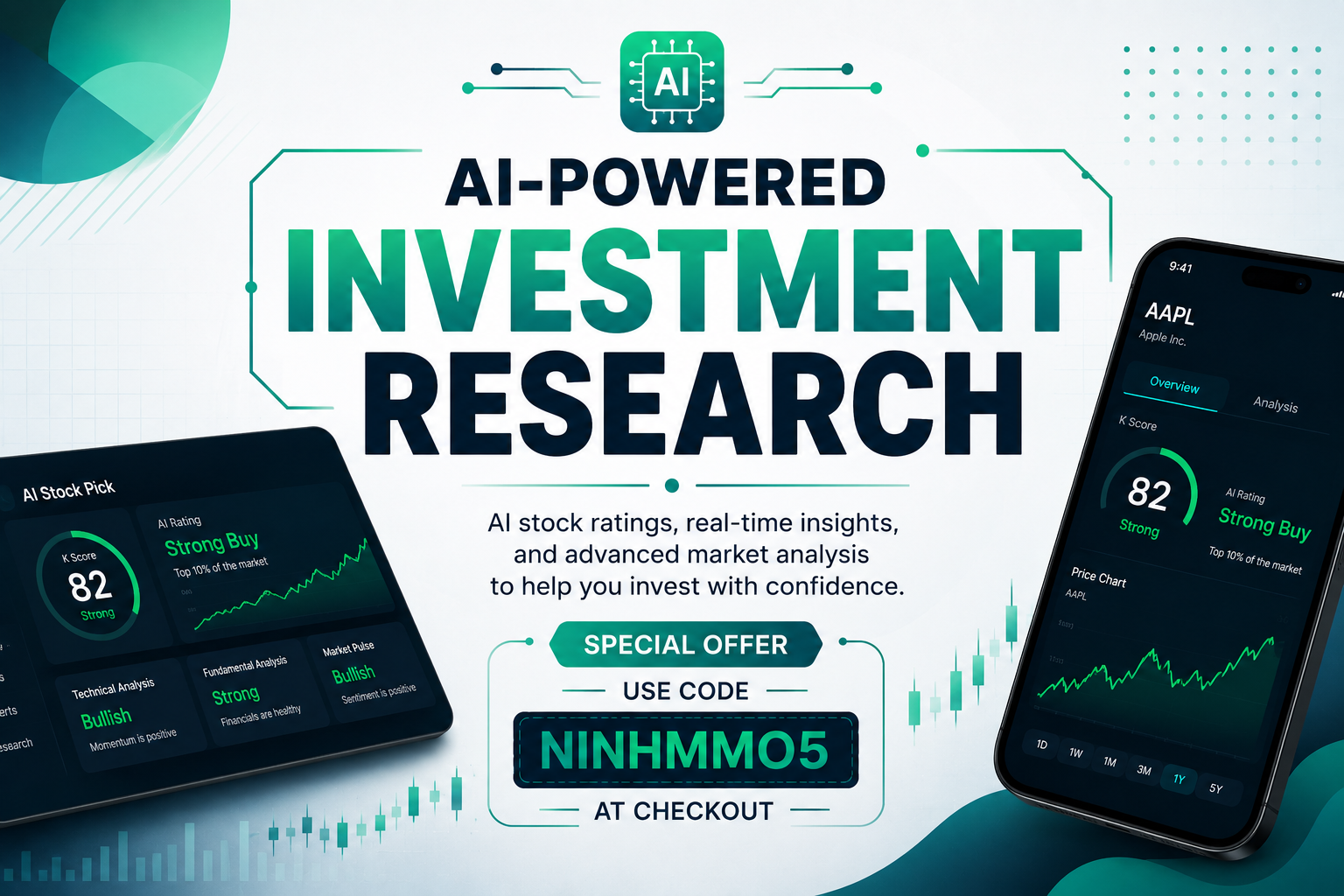
Explore Kavout and use code NINHMMO5 at checkout to enjoy the available offer.