

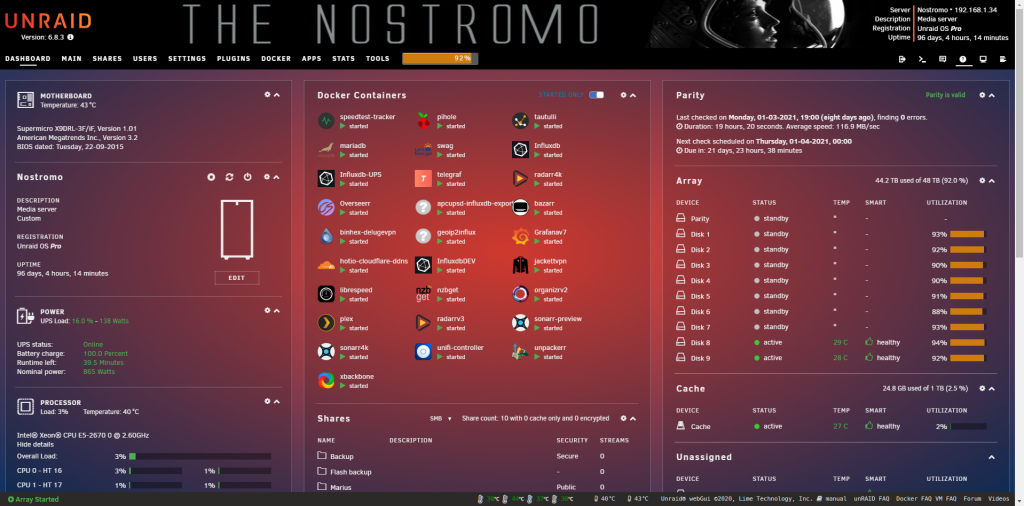
Unlike RAID 5 or RAID 6, which stripe data across all physical drives, Unraid stores individual files intact on single, independent hard drives, protected by 1 or 2 dedicated Parity drives.
| Feature | Traditional RAID (RAID 5/6) | Unraid Array |
| Mixing Drive Sizes | No (restricted by smallest drive) | Yes (as long as Parity is the largest) |
| Capacity Expansion | Requires complex parity rebuilds | Simply insert any new drive |
| Multi-Drive Failure | Total array data loss | Loss limited strictly to failed drives |
| Write Speeds | High (striping) | Moderate (limited to single-drive speed) |
- Parity Mechanism: The Parity drive must match or exceed the capacity of the largest data drive in the array. If a data drive fails, Unraid uses XOR calculations to reconstruct lost data seamlessly.
- Key Advantage: When reading a file, only the drive containing that file spins up. Remaining drives remain in standby (Spin-down), reducing operating temperatures and mechanical wear.
Rating: 9.5/10 for array flexibility and data safety.